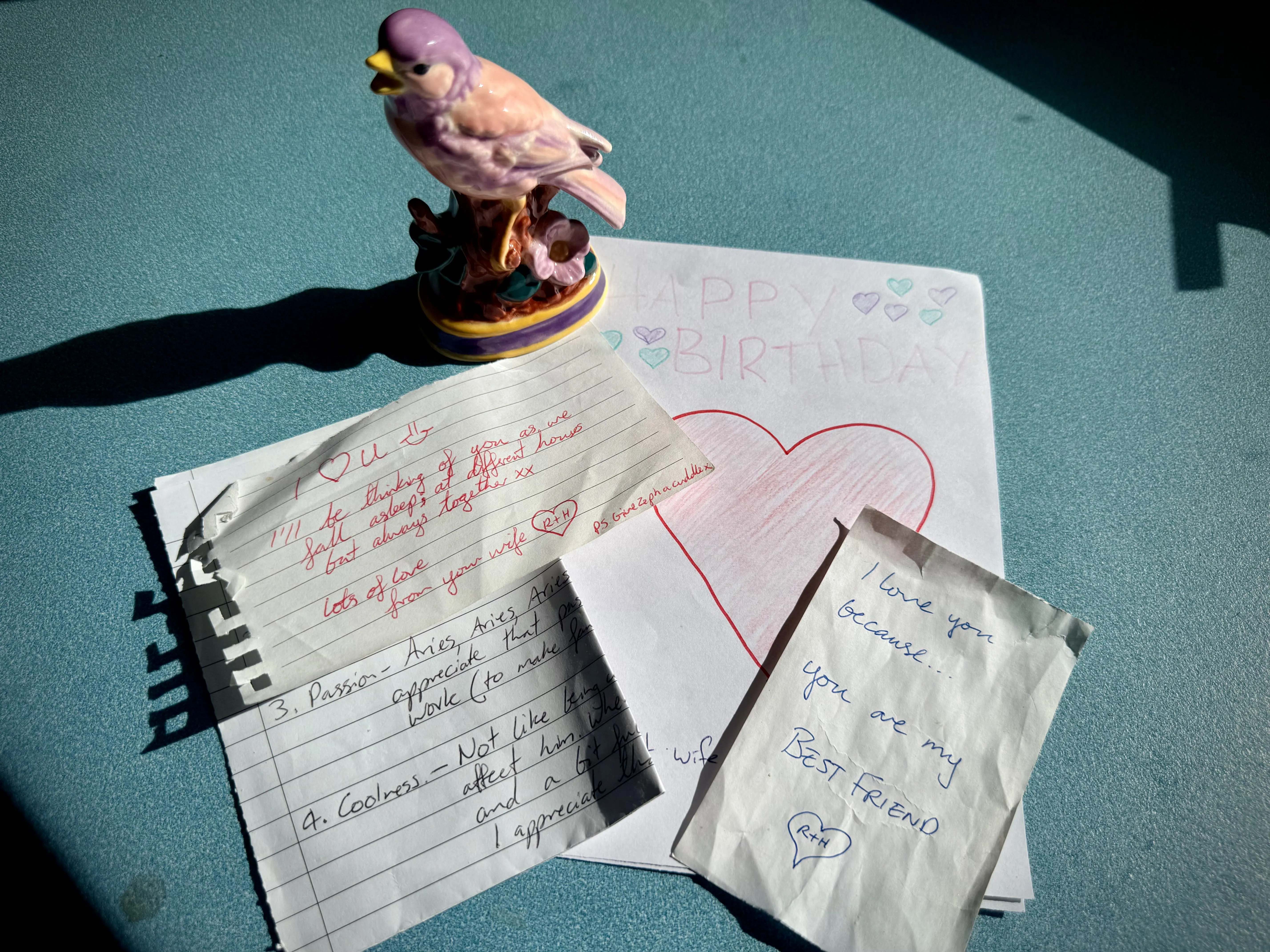
Sentimental things tend to gather quietly.
A birthday card is tucked into a drawer because the message inside feels too lovely to throw away. A handwritten letter is folded back into its envelope and placed somewhere safe. A small handmade object moves from a shelf into a box once space gets tight. None of these decisions feels significant at the time, but over the years they become a collection.
What makes that collection difficult to deal with is not the practical value of the objects themselves. Most are inexpensive, fragile, or impossible to replace in any meaningful sense. What matters is the person attached to them.
A card matters because of who wrote it. A letter matters because of the words and the handwriting. A handmade gift matters because someone spent time making it. Even a small object with no obvious monetary value can become difficult to discard if it represents a particular person, place or period of life.
That is why preserving sentimental things is not really about keeping every object forever. It is about understanding what part of the object carries the meaning, and then choosing a way to preserve that well.
Why sentimental objects are so difficult to declutter
Most household objects are relatively easy to evaluate. We ask whether we use them, whether we need them, whether they still work, or whether they are worth the space they occupy.
Sentimental objects resist that kind of logic.
A handwritten card may have sat untouched in a drawer for ten years and still feel impossible to throw away. A small gift from a grandparent might not be something you would ever buy yourself, but that is almost beside the point. Its value comes from association rather than usefulness.
That is why conventional decluttering advice often feels inadequate here. Asking whether something has been used recently does not help much when the thing in your hand is the last birthday card someone wrote to you, or a slightly crooked craft your child made at five.
The attachment is real, and it deserves to be treated seriously.
At the same time, keeping everything can create its own problem. When drawers and boxes fill with cards, letters, crafts and small objects, the important pieces can become buried among the rest. A collection intended to preserve memories can slowly turn into storage you avoid opening because there is simply too much inside.
The aim, then, is not to become less sentimental. It is to become more deliberate about what you are preserving and why.
Different keepsakes need different kinds of care
Not every sentimental object needs the same treatment.
A handwritten letter and a small ceramic gift carry meaning in different ways. One is mainly about words, handwriting and paper. The other may be about shape, texture, wear, and the memory of holding it.
Understanding that difference makes it much easier to decide whether the original should be kept, whether a digital copy is enough, or whether both make sense.
Handmade cards
Handmade cards often carry several layers of meaning at once. There may be a drawing on the front, a message inside, a signature on the back, and small details such as stickers, folds, fingerprints or spelling mistakes that give the card its character.
If you are preserving a card digitally, it is worth capturing all the parts that matter rather than only the front. The inside pages, the back, and any handwritten message can become more important years later than the decorated cover.
Cards that feel especially significant are often worth keeping physically as well, particularly when the paper, texture or construction is part of what makes them special.
Handwritten letters
Letters are different because the words are usually the heart of the keepsake, but the handwriting is part of the memory too.
We tend to think of handwriting as a way of delivering language, yet over time it can become inseparable from the person who wrote it. The slope of the letters, the pressure of the pen, a familiar signature, or the way someone always formed a particular word can become deeply recognisable.
That is one reason old letters can feel so powerful years later. You are not simply reading the message. You are seeing physical evidence of the person who wrote it.
For important letters, it is worth preserving every page, and sometimes the envelope too. A date, address, postmark or handwritten note on the outside may eventually hold more meaning than you expect.
Children’s crafts
Children’s crafts bring a different problem because they rarely fit neatly into folders.
They can be bulky, fragile, and made from materials that were never designed to survive for decades. Cardboard warps, glue dries out, pipe cleaners bend, paint flakes, and three-dimensional projects have a habit of losing pieces.
Some are absolutely worth keeping physically, especially favourites or objects with a particular story behind them. Others may be better preserved digitally before the materials begin to deteriorate.
For these kinds of keepsakes, a single front-facing photograph is not always enough. Several angles can preserve the shape and construction more faithfully, especially when part of the memory lies in how the object was made or what the child said it represented.
Small gifts and meaningful objects
Some keepsakes were never meant to become keepsakes at all.
A keyring, a shell, a small toy, a ticket, a piece of jewellery, or an ordinary household object can become meaningful because of where it came from or who gave it to you.
These are often the hardest things for anyone else to understand. To another person, the object may look completely unremarkable. Without its story, there may be no obvious reason it was saved.
That is precisely why context matters so much with sentimental objects.
When the original is worth keeping
There are some things where the physical object is part of the memory itself.
A handwritten letter from someone important. A child’s first handmade card. A small gift that belonged to a family member. An object whose texture, wear or imperfections are inseparable from the person or moment attached to it.
In those cases, keeping the original makes sense because physical objects carry qualities that digital preservation cannot fully reproduce. Paper has weight. Ink fades. A fold can show how a letter was carried or stored. A handmade object holds fingerprints, uneven edges and tiny imperfections that make it unmistakably itself.
If the object gives you something that a photograph cannot, that is a good reason to keep it.
The more useful question is whether every sentimental object needs that same treatment. Often, it does not.
When a photograph or digital copy is enough
There are also many keepsakes where preserving the image and story matters more than keeping the original indefinitely.
A large card that is difficult to store, a fragile craft, a duplicate object, or something meaningful mainly because of its story may not need to stay physically in the house forever.
Photographing or scanning these items can preserve what they looked like while giving you more freedom to decide what happens to the original. For flat pieces such as letters and cards, a clear image may be enough as long as every meaningful side or page is preserved.
Three-dimensional objects usually benefit from a little more care. Several photographs can capture the front, back, sides and any unusual details, while some objects benefit from 3D preservation because their meaning lives partly in their shape rather than on a single surface.
The aim is simply to preserve enough of the object that, years later, you can still recognise why it mattered.
A few simple ways to protect the originals you keep
Sentimental objects do not need museum-level conservation, but a little care can make a significant difference.
Paper tends to last better when it is stored somewhere dry, stable and away from strong sunlight. Damp cupboards, garages, attics and places with large temperature changes are generally harder on cards and letters over time.
For particularly meaningful paper items, archival-quality sleeves, folders or boxes can offer extra protection. The benefit is less about creating a formal archive and more about keeping the piece clean, flat and separated from materials that may damage it.
It also helps to store letters, photographs and cards in a way that does not require constant handling just to find something else. A simple labelled folder or box often works better than an elaborate system because it is much easier to maintain.
Three-dimensional objects need more common sense than technical expertise. Delicate pieces should not be crushed beneath heavier items, moisture should be avoided, and fragile objects should not be left loose in a box where they can move around and break.
The goal is not perfection. It is to give the originals you care about a reasonable chance of lasting.
Preserve the whole object, not just the obvious side
One of the easiest mistakes to make when digitising sentimental things is to preserve only the part that seems important at first glance.
A card is photographed from the front, but the handwritten message inside is forgotten. A letter is saved without its envelope. A child’s craft is photographed from one angle even though there is a drawing or inscription on the back.
Years later, those overlooked details may be the things you value most.
If something has multiple sides, pages or layers, it is worth taking a moment to think about what a future version of you might want to see. In many cases, the answer is more than the front.
This is especially true of handwriting. A name, date, short message or signature can become unexpectedly meaningful with time. A child’s handwriting changes quickly. An older relative’s handwriting may eventually become something you recognise instantly before you have even read the words.
Preserving the writing is part of preserving the person.
The story is what turns an object into a keepsake
A photograph can preserve the appearance of an object extremely well. What it cannot do on its own is explain why you cared about it.
Years later, you may find a photo of an old card in your camera roll and recognise the handwriting without remembering the occasion. You may see a small handmade object and no longer remember who made it, how old they were, or the story they told you when they handed it over.
That is the weakness of relying on the camera roll alone. The image survives, but the memory around it can fade.
A few details can prevent that.
Who made or gave it to you? When? Was there an occasion? How old were they? Why did you keep it? Is there something about the object that would not be obvious to someone looking at the image?
Those details do not need to become a formal catalogue. A sentence or two is usually enough to preserve the part of the memory that lives outside the object.
Keeping different kinds of memories in one place
One of the difficulties with sentimental things is that they rarely fit neatly into a single category.
A family collection might contain children’s artwork, birthday cards, handwritten letters, objects from grandparents, handmade crafts and small gifts, all of which need slightly different forms of preservation.
That is part of the thinking behind Keepsake.
Rather than treating every memory as a generic photograph, Keepsake is designed around different kinds of physical keepsakes. Cards can be captured with their multiple sides, letters can preserve more than one page, artwork can be saved with its context, and meaningful objects can be captured in a way that reflects their physical form.
The story stays alongside the object rather than somewhere else entirely, so authorship, dates, ages and notes remain connected to the thing they describe.
It does not replace the physical originals you want to keep. It gives the wider collection somewhere to live when the drawer, box or shelf no longer needs to hold everything.
Giving sentimental things a life beyond the drawer
There will always be objects worth keeping simply because holding the original matters, and there will be others where the physical thing matters less than the person, handwriting, story or moment attached to it.
The useful distinction is not between what is valuable and what is disposable. It is between the different ways something can be preserved.
A letter may belong in a box for the rest of your life. A handmade card may be worth keeping physically for a decade and digitally after that. A fragile craft may survive best as a set of images and the story your child gave it. A small object may need several angles before you are comfortable letting the original go.
There is no single rule that works for every keepsake, because the meaning lives in different places.
Sometimes it is in the object itself. Sometimes it is in the handwriting. Sometimes it is in the person who made it, or the ordinary moment in which it was handed to you.
Most often, it is some combination of all of them.