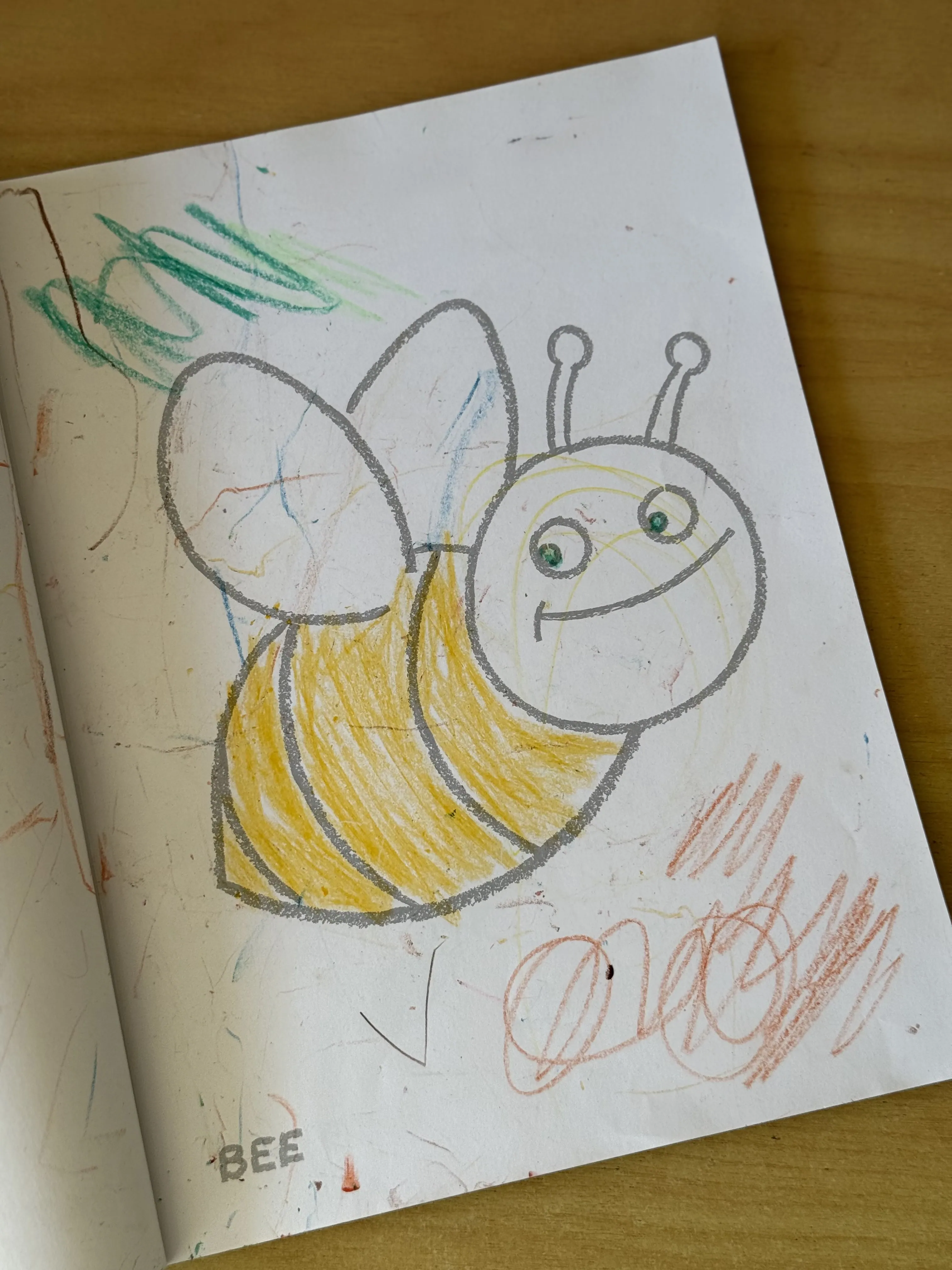
There is a point at which keeping every piece of children’s artwork stops feeling sentimental and starts feeling impossible.
The paper multiplies faster than any system can comfortably contain it. Drawings come home from preschool and school, cards appear after birthdays and holidays, paintings dry on kitchen benches, and small handmade objects accumulate on shelves. What begins as a handful of things worth saving can, within a few years, become a surprisingly large physical archive.
The difficulty is that most parents do not actually want to get rid of everything. They want to keep the meaningful parts, but working out what those are can be harder than it sounds.
A drawing may look ordinary until you remember that it came from a particular phase. A handmade card might matter because of the handwriting. A strange little construction may be impossible to store neatly, but difficult to part with because of the story attached to it.
That is where the tension sits. You know you cannot keep every physical object forever, but you also know that some of these things hold more than paper, paint or cardboard. They carry a particular age, a favourite subject, a family joke, or a version of your child that will not exist in quite the same way again.
The question, then, is not simply how to declutter children’s artwork. It is how to preserve enough of it that letting go of the original does not feel like losing the memory.
Why keeping everything eventually stops working
When children are very young, keeping most of what they make can feel manageable. There are only a few pieces, the first drawings seem obviously important, and a single memory box or folder feels like it will be more than enough.
Then the volume changes.
One year of artwork becomes several. The fridge gets cleared into a drawer, the drawer into a box, and the box into another box. The things that once felt special can become harder to distinguish because there is simply so much material around them.
This is often where parents end up feeling caught between two unappealing options: keep everything and accept the clutter, or throw things away and feel guilty about it.
But preserving childhood does not require preserving every physical object that passes through it. In fact, keeping too much can sometimes make the meaningful pieces harder to see.
What matters is recognising which pieces carry something worth remembering and then preserving those well enough that their meaning survives, even if the original does not.
Preserving artwork is not the same as preserving every object
It helps to separate two ideas that are often treated as the same thing: keeping the physical object and keeping the memory attached to it.
Sometimes both matter equally. A particularly special drawing may be worth framing or placing in a portfolio. A handmade card may belong in a memory box. A small object may be meaningful enough that you want the original to stay with the family indefinitely.
In other cases, the object is only one part of what you are trying to protect.
A large painting on thin paper might not survive years in storage. A cardboard construction may be difficult to keep intact. A stack of drawings may include several pieces you care about, even though you know there is no practical reason to keep every sheet of paper forever.
In those situations, preserving the artwork can mean preserving what it looked like together with the details that made it meaningful.
The original object does not have to carry the entire responsibility of preserving it.
A simple way to decide what is worth keeping
There is no perfect formula for choosing which pieces of children’s artwork deserve to stay.
The most meaningful collections are rarely complete. They are selective enough that the pieces inside them still feel distinctive, and they tend to contain the things that reveal something about the child who made them.
Firsts are often worth keeping because they show where something began: the first recognisable face, the first attempt at writing a name, the first drawing brought home from school, or the first handmade card. These moments can pass without much ceremony at the time, but years later they can become clear markers of how quickly things changed.
The same is true of pieces that feel unmistakably connected to a particular phase. A page full of dinosaurs during a dinosaur obsession, a drawing of the family dog repeated in exactly the same way every time, or an elaborate map of an imaginary place can all say more about a child than a technically better drawing ever could.
Then there are the pieces where the story matters more than the artwork itself. Perhaps the drawing came after a first day at a new school, or was made for someone who was away. Maybe your child spent ten minutes explaining what was happening in the picture with such conviction that the explanation became the thing worth remembering.
And sometimes there is no deeper justification at all. You simply love it. It makes you smile when you see it, and that is reason enough.
The opposite is also true. Duplicate drawings, routine worksheets, unfinished colouring pages, and things kept only because throwing them away feels bad do not all need to become permanent keepsakes.
If guilt is the only thing keeping an object in the house, it may be worth asking whether the memory itself could be preserved in another way.
Physical originals, photographs, and digital preservation
Once you have decided which pieces matter, the next question is how to preserve them.
For some artwork, the physical original is worth keeping. Framed drawings, memory boxes, folders and portfolios all work well for pieces you want to hold onto as objects, and there is something valuable about being able to handle the original years later.
For other things, photographing the artwork makes more sense. It allows you to preserve what the piece looked like without storing every original forever, and it can be especially useful for large, fragile or awkward pieces that were never going to survive particularly well in a box.
The limitation is that a photograph on its own can become detached from the story surprisingly quickly.
Years later, you may still have the image but no longer remember how old your child was, where the drawing came from, what they called it, or why you decided to photograph that particular piece in the first place.
This is where digital preservation becomes more meaningful when it includes context. The image preserves the artwork, but the surrounding details are often what allow the memory to make sense when you return to it later.
What is worth recording alongside a piece of artwork
You do not need to document every detail for a piece of artwork to remain meaningful.
In most cases, a few small pieces of context are enough.
The child’s age immediately places the artwork in a particular stage of childhood. A date, even an approximate one, can do the same. If they gave the piece a name or explained what it represented, that is often worth recording too, especially because those explanations have a habit of disappearing long before the object does.
The most useful detail may simply be why you chose to keep it.
Perhaps it was the first drawing of your family. Maybe it came home after a difficult week. Perhaps the artwork itself was fairly ordinary, but the conversation around it was funny enough that you knew you wanted to remember it.
Sometimes a single sentence does all the work.
Age five. He said this was our house on the moon and spent the rest of dinner explaining how the garden worked without gravity.
Years later, that line may do more to bring the moment back than the image itself.
Why digitising artwork can make it easier to let go
For many parents, the hardest part of sorting children’s artwork is not deciding what matters. It is the moment when something meaningful has to leave the house.
Digitising a piece can soften that decision because it creates another path between keeping everything and losing it completely.
A large painting can be preserved without occupying half a portfolio. A cardboard sculpture can survive as a memory without needing to make it through several house moves. A favourite drawing can keep its story even after the paper begins to fade.
This does not mean digital preservation should replace physical keepsakes. The two can sit comfortably alongside one another.
Some things are worth keeping in the box. Some deserve a place on the wall. Others can be captured carefully, given enough context to remain meaningful, and then let go.
That flexibility is often what makes the whole process feel more manageable.
Make it an ongoing habit, not a sorting marathon
One of the easiest ways to make preserving children’s artwork feel overwhelming is to treat it as a single large project.
If there are already several years of drawings in drawers and boxes, the thought of sorting everything in one weekend can make the task feel heavier than it needs to be. Each decision starts to carry too much weight, and the result is often that nothing gets sorted at all.
A smaller habit works better.
When something meaningful comes home, enjoy it first. Put it on the fridge or somewhere visible. Ask your child about it. Listen to the explanation, especially when the explanation is far more interesting than the picture itself.
Later, when it is time to make space, decide whether the original really needs to stay.
If it does, give it somewhere intentional to live. If it does not, preserve it while the details are still fresh.
Keepsake was designed for this kind of memory keeping. It allows you to capture selected artwork and keep the story alongside it, whether that is the child’s age, the date, who made it, what they called it, or simply the reason the piece mattered in the first place.
The idea is not to create a complete digital archive of every drawing your child ever made. That would simply recreate the same problem in another form.
It is to make sure the meaningful ones do not lose their story when the paper eventually leaves the house.
A smaller collection can hold more meaning
There is something reassuring about accepting that childhood does not need to be preserved in full.
No archive could contain every drawing, every note, every strange little object, or every ordinary moment anyway. Even if it could, the sheer volume would make it difficult to recognise the things that mattered most.
The pieces that tend to stay with us are usually the ones that carry something particular: a first, a favourite, a phase, a story, or a small glimpse of who a child was at that age.
A smaller collection can feel more meaningful precisely because each piece still has room to be noticed. You can look at it and remember why it survived the sorting process in the first place.
What matters is preserving the things that still have something to say.