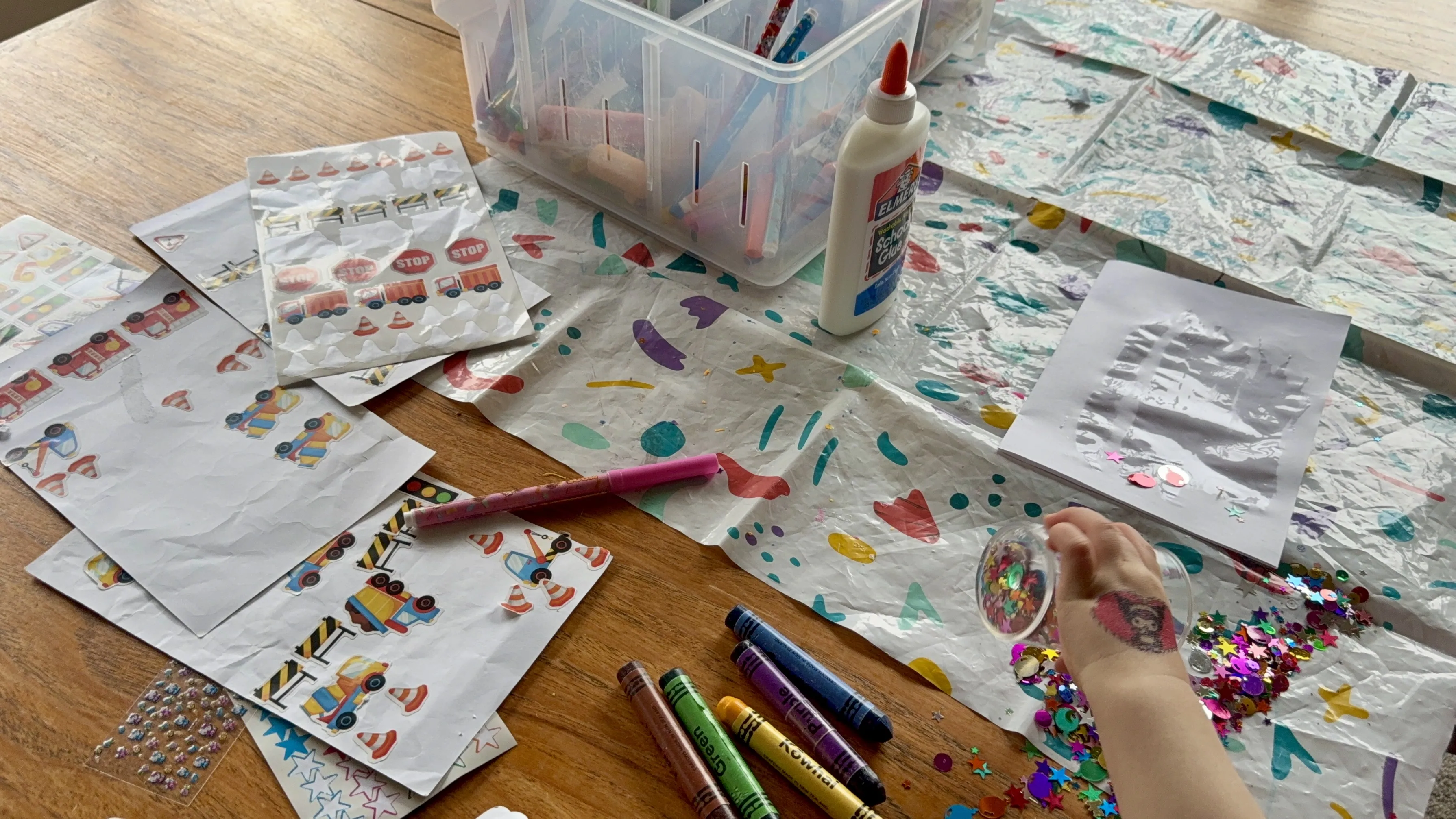
Children’s artwork rarely becomes overwhelming all at once. It happens gradually, in the background of family life.
A few drawings go on the fridge. Then more arrive from kindy or school. A folder is started. A pile forms beside it. Someone moves that pile into a drawer. A larger piece gets rolled up because it does not fit anywhere else. Cards, paintings, certificates and little paper constructions begin to mix together, and before long there is not really a system at all. There is just a history of good intentions.
The difficult part is that most of the artwork does not feel meaningless. Some of it is ordinary, but some pieces carry a particular age, phase or memory, and that makes the whole pile harder to sort.
When parents ask how to organise years of children’s drawings, the instinct is often to look for the perfect system: the right folders, the right labels, the right boxes, the right filing method.
But the best system is rarely the most elaborate one. It is the one you can still imagine using a year from now.
Why children’s artwork becomes overwhelming so quickly
The volume is the first problem.
Young children create constantly, and the work comes from everywhere: school, preschool, grandparents’ houses, rainy afternoons, holidays, restaurants, birthday parties and quiet moments at the kitchen table. A few meaningful pieces can quickly become hundreds of sheets of paper.
The second problem is variety. Some things are flat, some are oversized, some are fragile, and some are only technically artwork because they contain enough glue and cardboard to resist classification.
Then there is the emotional side of it.
If these were ordinary papers, organisation would be simple. You would keep what was useful and recycle the rest. But children’s artwork sits in a different category. A drawing can represent a phase that has already passed. A piece of handwriting can feel important because you know it will not look that way for long. A simple picture can hold a story that no one else would recognise by looking at it.
That is why organising the pile is not really just about storage. It is about creating enough structure that the meaningful pieces can be found again.
Reduce the volume before you organise it
The easiest way to make any storage system fail is to ask it to hold everything.
Before thinking about folders, boxes or digital organisation, it helps to reduce the volume. This does not need to mean ruthless decluttering. The goal is simply to separate the pieces that genuinely matter from the ones you are keeping by default. If that feels difficult, this guide to preserving your child’s artwork without keeping every piece offers a practical way to decide.
Start with the obvious things. Duplicates, routine worksheets, unfinished colouring pages and pieces you do not remember or particularly like can usually go. Then look for the artwork that tells you something: a first, a favourite, a phase, a milestone, or a piece with a story attached.
This is often the most important part of the whole process because a smaller collection is easier to organise, easier to store, and much more likely to be revisited later.
Trying to organise every piece of paper your child has ever touched may create a complete archive, but completeness is not necessarily the goal. The aim is to make the meaningful things visible.
Choosing a system that makes sense for your family
There are several sensible ways to organise children’s artwork, and none of them is universally best.
The right structure depends on what feels most natural when you imagine looking for something later.
For families with more than one child, separating artwork by child is usually the clearest first layer. Each child can have their own folder, portfolio, box or digital collection, and from there you can decide whether any further organisation is actually necessary.
A year-based system is equally straightforward. A folder labelled “2026” requires very little maintenance and is easy to understand years later. The trade-off is that calendar years do not always line up neatly with a child’s age or school stage.
Organising by age can feel more personal, particularly in the preschool and early primary years, when the differences between four, five and six can be dramatic. “Age 4” immediately tells you something about the person who made the work, rather than simply when it was made.
For school-aged children, school year often makes even more sense. “Year 1”, “Year 2” and “Year 3” naturally match the rhythm of how artwork comes home, and it can be satisfying to look back at a whole school year together.
Some families prefer to organise by milestone or theme instead: first drawings, family portraits, handwriting, favourite subjects, seasonal artwork or special projects. This can make a collection more emotionally interesting, but it also asks more of the person maintaining it.
For most families, a simple chronological system will be easier. The best rule is to choose a structure you can apply without having to stop and think every time a new piece comes home.
Physical storage that actually works
Once the collection has been reduced, physical storage becomes much easier.
For flat artwork, large portfolios and folders are usually the simplest options. They protect the originals, keep pieces in one place, and allow you to browse through them without unfolding or unpacking anything. A labelled folder for each year, age or school year is often enough.
Archival boxes can work well for larger collections or for families who want to keep paper flat and protected over time. They are also useful for combining drawings with cards, certificates and other flat keepsakes.
Memory boxes are better for mixed objects. If you want to keep a child’s drawings alongside letters, small crafts, first shoes, school items or other sentimental things, a box can make more sense than a folder.
The important thing is not to create too many categories. A system with twelve carefully labelled boxes may look impressive at first, but if it takes too much effort to decide where something belongs, the pile beside the system will eventually return.
Simple storage works because it reduces friction.
Digital organisation is more than taking photos
Photographing children’s artwork can be useful, especially for oversized, fragile or less important pieces that you do not want to store physically.
But a camera roll is not really an organisation system.
A photo can sit safely on your phone for years and still become almost impossible to find among holidays, screenshots, pets, dinners and everything else you have photographed. If digital copies are going to be part of your artwork system, they need some structure too.
That might mean creating an album for each child, organising by year, or using meaningful filenames if you are storing files elsewhere. Even a simple note with the child’s age or the year can make a big difference later.
Metadata matters for the same reason. An image of a drawing tells you what it looked like. A few details tell you what it meant.
If the artwork had a title, if your child explained what was happening in it, or if there was a reason you decided to preserve that particular piece, it is worth recording while the memory is still fresh. Without that context, even a beautifully organised digital archive can eventually become a collection of images you no longer understand.
A hybrid system often works best
For many families, the most practical answer is not fully physical or fully digital. It is a mixture of both.
Keep the physical originals that genuinely benefit from being kept as objects: favourite drawings, handwritten cards, meaningful firsts, or anything whose texture, size or imperfections are part of what makes it special.
Digitise the things you still want to remember but do not need to store forever. This is especially useful when you are deciding what to do with children’s artwork after you run out of space.
This approach gives you more flexibility. A folder or memory box can stay small enough to remain enjoyable to open, while the digital collection can hold the wider story without taking over the house.
Keepsake works naturally as a digital complement to that kind of system. Instead of simply photographing a drawing and letting it disappear into the camera roll, you can preserve the piece alongside details such as age, date, who made it and why it mattered.
That makes the digital side of the collection feel less like storage and more like a family archive you can actually return to.
Avoid systems that create another parenting chore
There is a particular kind of organisation system that looks wonderful in theory and becomes exhausting in practice. It usually involves too many labels, too many categories, too much scanning, too much renaming and too much pressure to keep everything perfectly up to date.
If the process of preserving memories starts to feel like administration, the system is probably too complicated.
Busy families need low-friction systems.
A folder by year.
A box by child.
A small digital habit for selected pieces.
That is enough.
The aim is not to build a museum-quality catalogue of childhood. It is to make sure the meaningful things can still be found later.
A slightly imperfect system that gets used is far more valuable than a perfect one that collapses after three months.
Review occasionally instead of cataloguing perfectly
Artwork collections benefit from being reviewed from time to time, not because they need constant maintenance, but because perspective changes.
Something that seemed essential to keep at the end of the school year may feel less important a year later. Another piece you almost discarded may become more meaningful because you now recognise what it represented.
A periodic review gives you a chance to reduce the collection again and keep it manageable without turning organisation into an ongoing project. Once or twice a year is usually enough.
You might do it at the end of the school year, around a birthday, or simply whenever a folder becomes full. The point is not to re-evaluate every decision endlessly. It is to give the collection enough attention that it does not quietly turn back into another pile.
Preserve the context, not just the categories
Organisation is useful because it helps you find things, but finding the piece is only part of the value.
A perfectly labelled folder can tell you that a drawing came from Year 2. It cannot tell you why that particular drawing mattered.
That story often lives outside the artwork itself. Maybe it was the first time your child drew the whole family. Maybe they made it for someone they missed. Maybe the strange shape in the corner had a name and a whole explanation that made perfect sense at the time.
Those details are easy to lose if the focus is only on sorting.
The strongest family memory systems do both jobs. They organise the objects well enough that they can be found, and they preserve enough context that the objects still make sense when they are found.
That is what turns a storage system into something worth revisiting.
A collection you can return to
The best way to organise years of children’s drawings is not to create the most comprehensive archive possible. It is to create a collection that still feels approachable.
A few folders you can open without dread. A memory box that still contains things worth handling. A digital collection where the stories have not been separated from the images.
The aim is not perfection. It is usefulness.
Because a smaller collection that you can find, understand and revisit will always be more meaningful than a complete archive you never open. That is also why revisiting memories matters more than simply saving them.