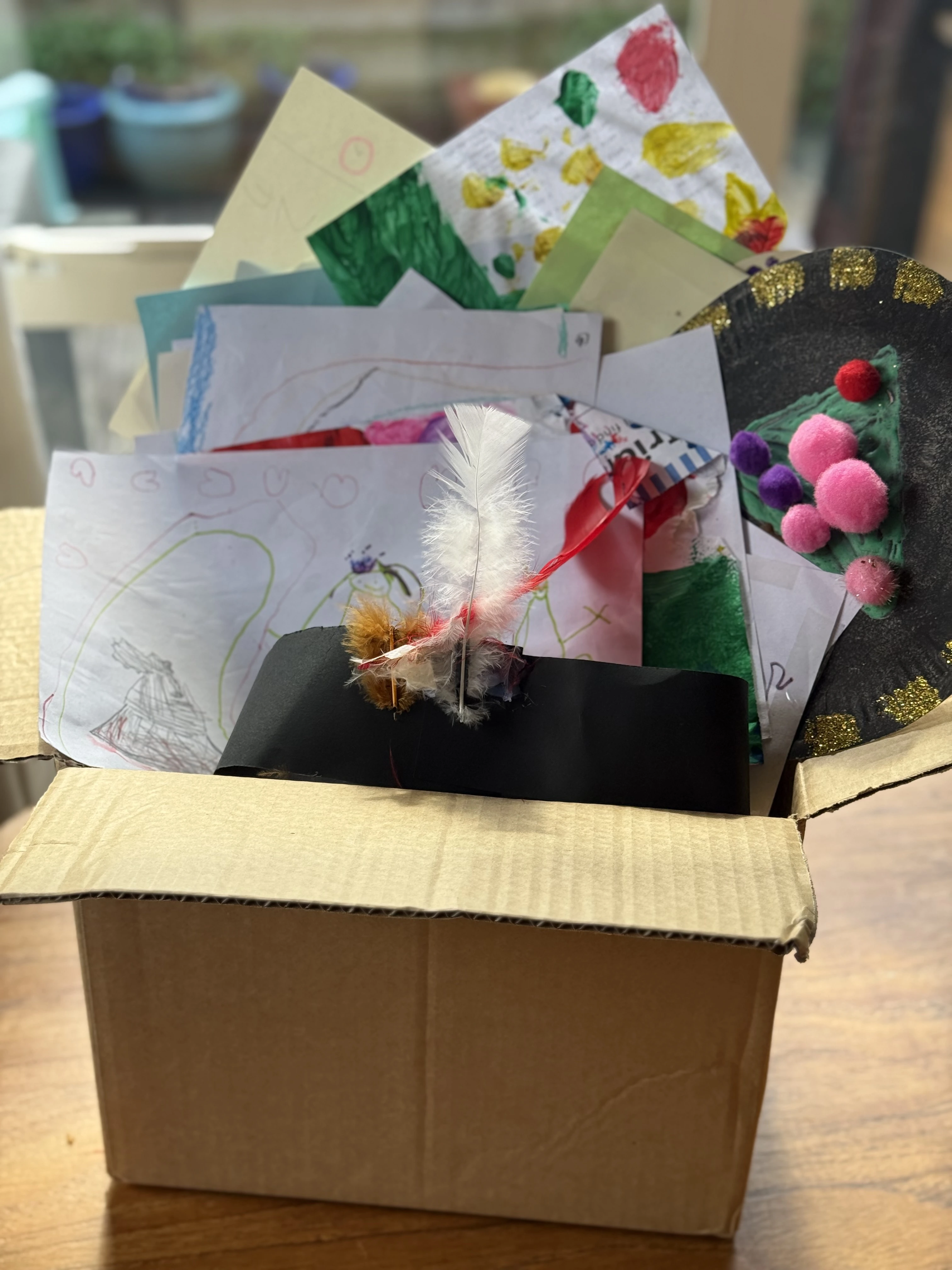
At first, it feels impossible that a few pieces of paper could ever become a storage problem.
Then school starts.
Drawings come home in backpacks. Paintings appear from kindy. There are worksheets with little pictures in the margins, cards made for every imaginable occasion, folded notes, cut-out shapes, glued-on feathers, and increasingly ambitious constructions that do not fit neatly anywhere.
The fridge gets covered first, then the kitchen bench, and eventually a drawer becomes the place where artwork goes “for now”.
Before long, that temporary pile has become a permanent one.
For sentimental parents, this can be surprisingly difficult to deal with. You know you cannot keep every single thing your child makes, but throwing something away can feel uncomfortably close to deciding that it did not matter.
That is where the problem becomes bigger than storage.
It is how to recognise what is worth keeping.
And how to preserve the parts of childhood you will actually want to return to later.
The problem is not the artwork
Children are prolific.
They draw because they are bored, because they are excited, because they are waiting for dinner, because someone put a pen in front of them.
They draw at school, at home, at restaurants and at grandparents’ houses, and a preschooler can produce more artwork in a month than most adults manage in a decade.
This is a good thing.
Making is part of how children explore the world, and their drawings and handmade objects change as they do. The marks become recognisable shapes, the shapes become people, and eventually there are whole scenes filled with details that tell you something about what they were interested in at the time.
The difficulty is simply the volume.
When there are only a handful of drawings, each one feels significant. When there are several hundred, it becomes harder to see which ones actually mean something.
That is usually when guilt starts to creep into the decision-making. You begin keeping things because throwing them away feels wrong, rather than because you genuinely want to preserve them.
It can help to change the question.
Ask whether you would be glad to find it again in ten years.
That small shift makes the decision less about getting rid of something and more about recognising what is worth carrying forward.
You do not need to keep everything
There is no correct number of drawings to save.
Some families will keep a lot, while others will keep only a few pieces from each year. What matters is not the size of the collection, but whether the things inside it still feel meaningful.
A useful place to start is with the pieces that tell you something about the child who made them.
Keep the firsts
The first recognisable person, the first attempt at writing their name, the first drawing from school or the first handmade card can easily pass without much ceremony at the time.
Years later, these pieces often become some of the clearest markers of how quickly things changed.
They do not need to be beautiful or particularly accomplished.
Their value is in showing a beginning.
Keep the favourites
Not every piece needs to represent a milestone.
Sometimes something is worth keeping simply because you love it.
Maybe it makes you laugh every time you see it, the colours are unexpectedly beautiful, or your child has drawn the family in a way that feels completely true to that particular moment in your lives.
That is enough reason to keep it.
Keep the things that show who they were
Some drawings say more about a child than others.
A page covered entirely in dinosaurs during the year when dinosaurs were everything. A picture of the dog sleeping in exactly the same place he always slept. A carefully labelled map of an imaginary country.
These pieces become small records of personality.
Years later, they can bring back not only what your child drew, but what occupied their imagination.
Keep the things with a story attached
Often, the story matters more than the object.
A fairly ordinary-looking picture can become important because of what happened around it.
Perhaps they drew it after their first day at a new school, made it for someone they missed, or spent ten minutes giving you an elaborate explanation of what was happening in a picture that made complete sense to them and absolutely none to you.
Those are the details worth noticing.
There are also plenty of things you can let go of without losing anything important: duplicate drawings, routine worksheets, half-finished colouring pages, and pieces you cannot remember anything about and do not particularly like.
If the only reason you are keeping something is guilt, that may be a sign that the object itself is not the thing you are trying to preserve.
How to store and organise children’s artwork
Once you have decided what to keep, the next question is where to put it.
There is no single best way to store children’s artwork. Different approaches suit different families, and most people end up using a combination of physical and digital storage depending on the piece.
Folders and portfolios
Large folders are one of the simplest ways to organise flat artwork, particularly if you sort by year or age and keep only a selection.
The originals stay intact, and the collection is easy to look through.
The limitation is that folders still take up physical space, and larger or three-dimensional projects do not fit particularly well.
Memory boxes
A memory box can hold far more than drawings.
Cards, certificates, small crafts, letters and other sentimental objects can all live together in one place.
Part of the appeal is physical. Opening a box and handling the original things feels different from looking through digital images.
The difficulty comes when one box becomes two, then three, and eventually the memory boxes themselves become another storage problem.
Scrapbooks and photo albums
Scrapbooks offer a more deliberate way to preserve children’s artwork.
A favourite drawing can sit alongside a photograph, a date, or a note about why it mattered.
They can become beautiful family records, but they also take time.
They tend to work best for people who genuinely enjoy making them. A preservation system that feels like another unfinished project is unlikely to survive the busiest years of family life.
Photographing artwork
For most parents, taking a photograph is the easiest option.
It is quick, works for almost anything, and allows you to let go of the physical piece without losing it entirely.
The challenge is what happens afterwards.
A photograph taken today can be surprisingly difficult to find a few years from now.
It becomes one image among thousands, mixed in with holidays, screenshots, pets, dinners and every other part of family life captured on a phone.
The artwork survives, but the reason you cared about it can become much harder to recover.
The part that is easiest to lose is the context
Imagine finding a photograph of one of your child’s drawings ten years from now.
There is a green dinosaur, a large yellow sun and several figures standing beside something that may or may not be a volcano.
You will probably recognise that one of your children made it, but the details may already be hazier.
How old were they? Was it from school or from home? Why did you take a photograph of this particular drawing?
And will you remember that they had just learned about dinosaurs at kindy and then spent the next six months correcting everybody’s pronunciation of parasaurolophus?
Context records the memory.
Sometimes that context only needs to be a sentence:
Emma, age four. She drew this after learning about dinosaurs and insisted the little one was a baby T-Rex.
A note like that can make the picture mean something again years later.
This is the idea behind Keepsake.
It gives families a place to preserve children’s artwork, cards, letters and handmade objects alongside the details that would otherwise be easy to forget: who made something, how old they were, when it was created, or simply why you decided to keep it.
For physical objects where a photograph does not quite capture the whole thing, Keepsake can also preserve them in 3D.
The aim is not to digitise every piece of paper that enters the house.
It is to give the things you choose to preserve enough of their story that they still feel meaningful when you return to them later.
Creating a smaller, more meaningful collection
Sorting children’s artwork can feel like the kind of task that requires an elaborate system, particularly if the backlog already stretches across several years.
In practice, it is often easier to begin much smaller.
Take everything out and keep the pieces that immediately mean something to you.
For the things you want to preserve without keeping the original forever, capture them in Keepsake and add the details that give them meaning while they are still fresh: how old your child was, what they called it, where it came from, or simply why you chose to save it.
The rest can go.
There is no need to sort an entire childhood in a weekend.
In fact, trying to do too much at once can make every decision feel heavier than it needs to.
A small habit going forward is likely to make a bigger difference than one heroic afternoon spent tackling years of accumulated paper.
When something new comes home, enjoy it for a while.
Put it on the fridge. Ask your child what they made and listen to the explanation, especially when the explanation is much more interesting than the picture itself.
Then, when the fridge gets full, choose what stays.
Over time, the result is something much more useful than a complete archive of everything your child ever made.
It becomes a smaller collection that still feels like them: the funny drawings, the backwards writing, the favourite subjects, the unexpected little masterpieces and the things that take you straight back to a particular age or phase.
There will always be more paper than you can reasonably keep, and that is not a failure of organisation.
Childhood simply produces more things than any home could sensibly preserve.
The aim is not to build a perfect archive of it all.
It is to notice the pieces that hold something worth remembering, preserve them in a way that works for your family, and let the rest go without feeling that the memory has gone with them.