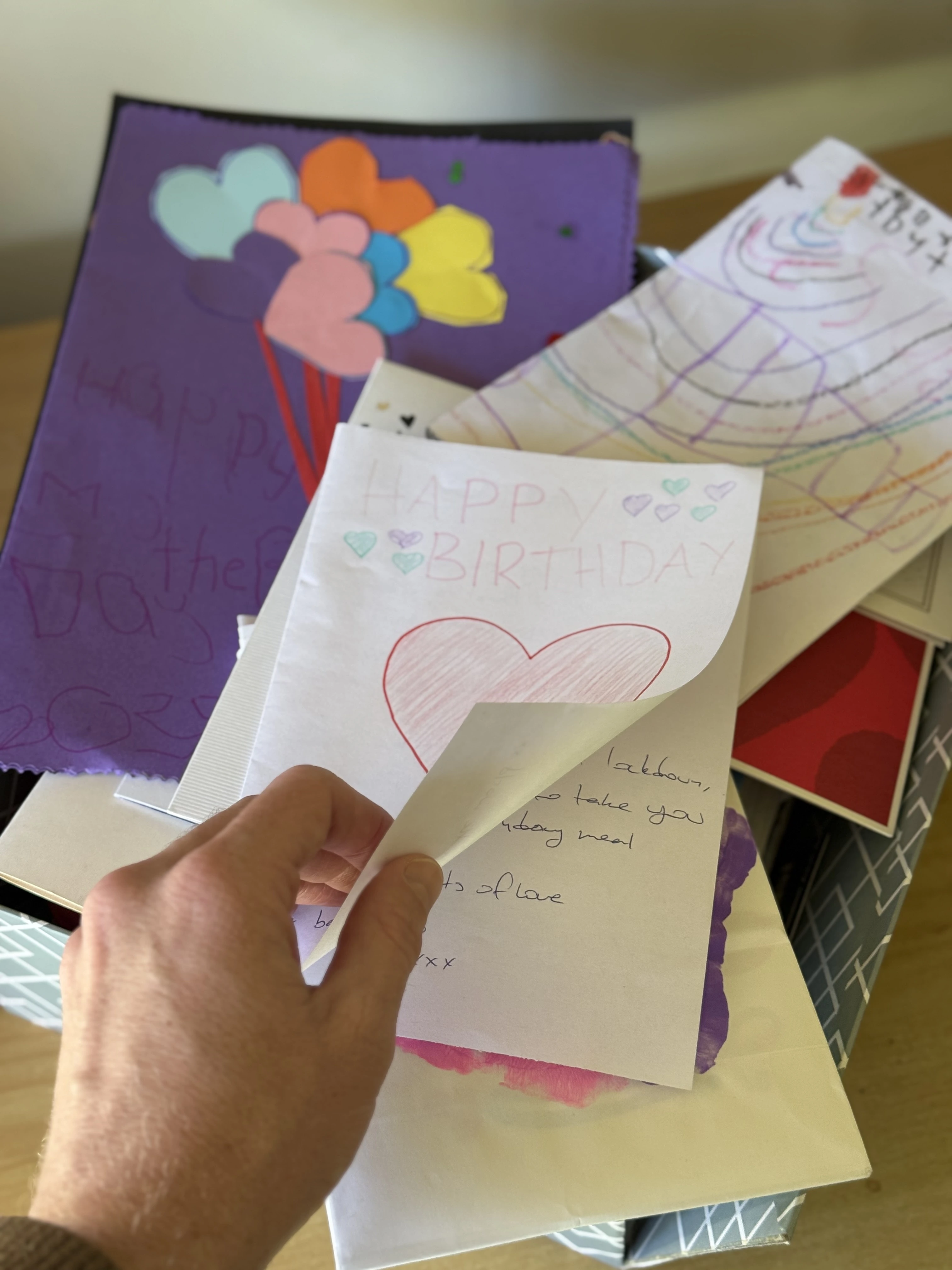
There is usually one place in the house where it all ends up.
A drawer that has become difficult to close. A shelf in the wardrobe. A box in the spare room that started out neatly organised and now contains a mixture of paintings, birthday cards, school certificates, folded paper, pipe cleaners, stickers and things you can no longer quite identify.
Every so often, you decide you are going to sort through it properly.
You pull everything out and make a few piles. Keep. Recycle. Maybe.
The obvious things are easy. A scribble on the back of a worksheet can probably go. So can the half-finished colouring page you do not even remember seeing before.
But then you find something else.
A drawing with a strangely shaped person in the middle. A card with your name written in enormous uneven letters. A small object made from cardboard and paint.
And suddenly the job becomes harder.
You can see, objectively, that it is just paper. You know there will be more. You know you cannot keep every drawing your child makes between the ages of two and twelve.
Still, you hold onto it for a little longer than you expected.
It is about everything attached to it.
That is the part of childhood clutter that is difficult to explain until you have lived with it.
The problem is not really that there is too much stuff.
It is that some of the stuff has quietly become attached to moments you do not want to lose.
The value is rarely in the object itself
The paper is not special.
The paint is not special.
The materials themselves are usually ordinary.
A handmade card, a small painted object, or a child's drawing would mean very little to someone who found it without knowing where it came from.
But add the story and everything changes.
- Who made it.
- How old they were.
- What they loved at that moment.
- What life looked like for your family when it was created.
The object is simply where the memory begins.
The meaning comes from everything around it.
Why these things become harder to throw away
Every parent eventually reaches the same question:
How much do I keep?
The first few things are easy. The first drawing. The first painting. The first card with their name written carefully across the front.
But children create constantly.
The collection grows faster than anyone expects.
The answer is not to preserve everything.
It is to recognise which things carry a story you want to remember.
A photo is useful, but it is not always enough
For many families, the solution has become simple:
Take a photo.
And there is nothing wrong with that.
Photos are one of the greatest ways we have to hold onto moments.
It does not always preserve why it mattered.
The most meaningful keepsakes need context.
They need the story behind them.
They need the little details that explain why this ordinary object became something worth keeping.
Preserving the memories behind the things we save
Children grow quickly.
The drawings on the fridge become school projects. The handmade gifts become fewer. The little objects created with complete confidence become reminders of an earlier version of themselves.
And one day, those memories may matter even more than they do now.
Not just because of what was made.
But because they remind us who they were.
Preserving memories is not about creating a perfect archive.
It is about protecting the small pieces of life that would otherwise disappear.
Keeping the story connected to the object
Keepsake was created from this exact feeling.
The feeling of looking at a pile of children's artwork and knowing that these things matter, while also knowing you cannot physically keep every single piece forever.
The goal is not to replace the objects.
It is to preserve what makes them meaningful.
The artwork. The cards. The letters. The handmade creations.
The things that hold a little piece of a particular moment in your family's story.
Technology can help preserve the object.
But the reason we preserve it has always been human.
You do not need to keep everything
You do not need every drawing.
You do not need every card.
You do not need every single thing your child creates.
But the things that matter deserve to be remembered properly.
Because one day, those ordinary objects may become some of the most meaningful things your family owns.
The value was never in the paper, the paint, or the cardboard.
It was always in the story.