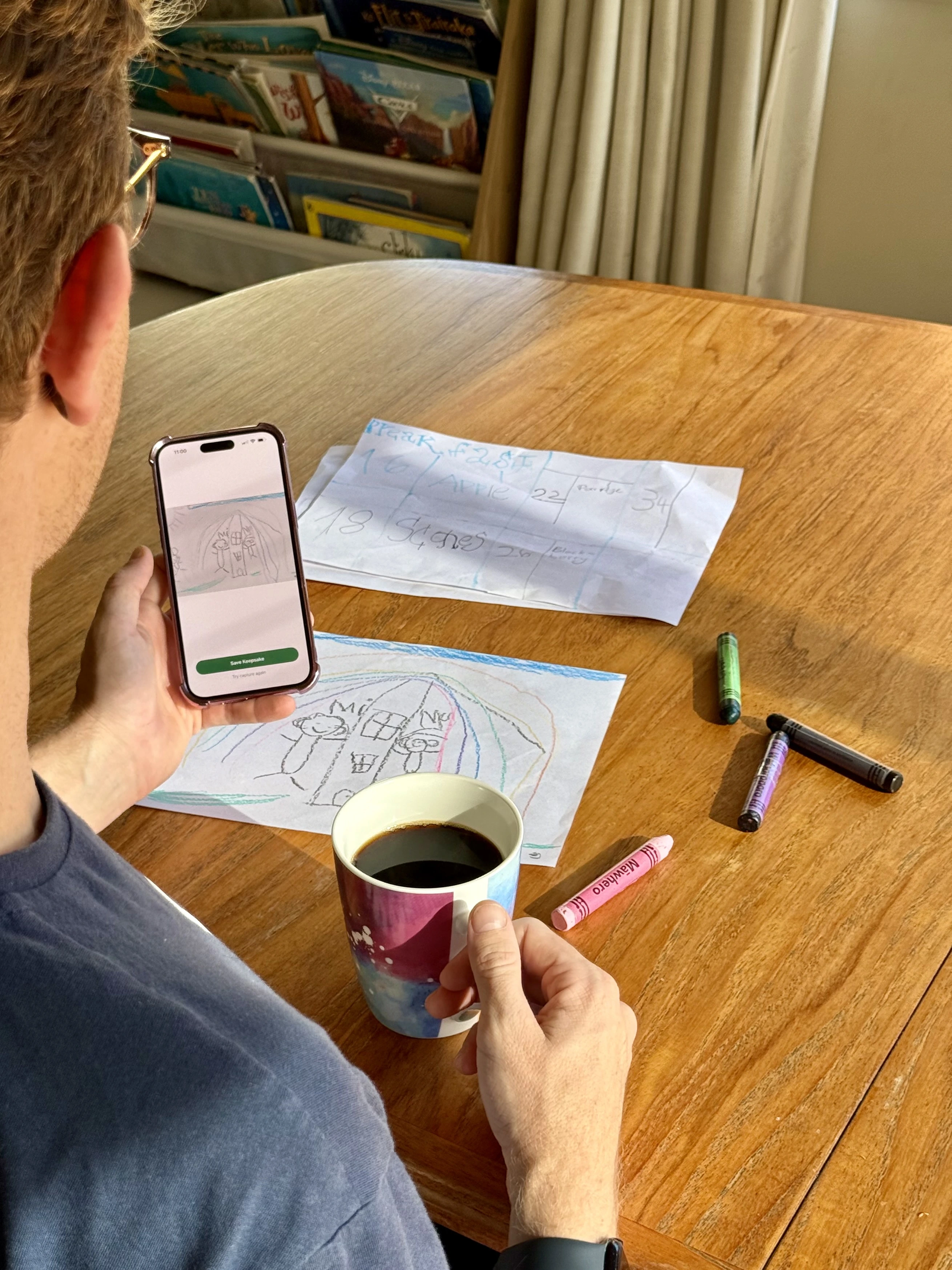
Most of us have thousands of photos on our phones, and most of them arrived there without much thought.
We take a picture because the light is good, because a child has done something funny, because we want to remember a first day, a birthday, a drawing, a school project, or some ordinary moment that feels worth keeping.
Then the phone goes back in our pocket and the day carries on.
The image is still there, of course.
It may be backed up, searchable by date or location, grouped by person, and stored more securely than family photographs have ever been stored before.
In practical terms, we have become exceptionally good at preserving moments.
That is the strange contradiction at the heart of modern memory keeping.
We can save almost everything, yet much of what we save quietly disappears from our lives.
It remains in the camera roll, in a cloud library, in an old folder, or in a box at the back of a cupboard, but it is rarely encountered again.
Nothing has been lost in the technical sense, yet over time an unseen memory can begin to feel surprisingly close to one that has been forgotten.
Storage is not the same as remembering
Digital storage has changed the way families preserve memories.
A phone can now hold more photographs than previous generations might have taken in a lifetime.
We can keep videos, messages, voice recordings, scans, schoolwork, and years of family life without needing to make many decisions about what deserves to stay.
There is almost always room for one more image.
That abundance is useful, but it has also made the act of keeping less deliberate.
When space was limited, preservation usually involved a choice.
A photograph had to be printed. A card was tucked into a drawer. A child's drawing was placed in a folder or memory box.
Even if the system was untidy, the act of keeping something physically gave it a certain weight.
Digital storage asks much less of us.
We save first and assume we can sort through it later, but later rarely arrives.
The archive grows, important images sit beside screenshots and receipts, and photos of meaningful objects become mixed into thousands of ordinary pictures from everyday life.
This is why storing memories and remembering them are not quite the same thing.
Remembering is about allowing it to become part of your life again.
That distinction matters because family memories are not only valuable as records.
Their value often comes from the feeling of recognition when something old unexpectedly returns to you.
Why revisiting memories makes them more meaningful
The meaning of a memory is not fixed at the moment it is created.
In many cases, it grows with time.
A drawing that seemed ordinary when your child was four may feel completely different when they are fourteen.
A birthday card written in uneven handwriting can become more affecting once that handwriting has changed.
A handmade object that once sat casually on a shelf may eventually come to represent an entire stage of family life.
The object has not changed, but the person returning to it has.
That is part of what makes revisiting memories so powerful.
When we see something again years later, we bring everything that has happened since.
Details that barely registered at the time begin to stand out, while the object itself can unlock memories that were never deliberately stored at all.
An old drawing might remind you of the kitchen table where it was made, the phase when every picture contained the same animal, or the way your child used to explain every detail with complete seriousness.
A handwritten note can bring back a particular turn of phrase.
A photograph can suddenly make you remember the sound of a voice or the feeling of a room you had not thought about for years.
Revisiting simply gives it a way back into the present.
This is why preserving family memories is only part of the work.
A memory that is carefully stored but never encountered again has been protected, but it has not necessarily remained connected to the life that followed it.
Why physical keepsakes feel different
Physical keepsakes often carry a kind of emotional weight that ordinary digital files do not.
Part of that comes from their imperfections.
A child's drawing may be creased. A card may have fingerprints on it. A clay figure might lean slightly to one side, and the handwriting on a note may wobble across the page.
These marks are easy to overlook, but they are also evidence that the object existed in a real moment and was handled by a real person.
A child's drawing is not only an image of something they created.
It is the actual piece of paper they touched.
The pencil moved across that surface, the paint dried there, and the folded corner happened somewhere between the classroom and home.
That physical connection is one of the reasons people find these things so difficult to throw away.
We are rarely attached to the materials themselves.
The paper, cardboard, paint, or clay may have almost no value on their own.
What matters is what the object carries with it: who made it, how old they were, what they were interested in, and what was happening in family life at the time.
This is why meaningful keepsakes deserve to be treated differently from ordinary files.
The aim is not simply to store them somewhere safely, but to preserve enough of their meaning that they can still be returned to later.
Designing technology around reflection, not attention
Most digital products are built around attention.
They encourage people to come back often, keep a streak going, respond quickly, check what they missed, or spend a little longer inside the product.
That model works for many things, but memories are different.
Family memories do not need urgency.
They do not need another engagement loop, and they do not need to become a task that has to be completed or a habit that has to be maintained.
Their value comes from the fact that they are personal, and revisiting them should feel more like reflection than obligation.
That is the philosophy behind Keepsake.
The aim is not to make someone open an app more often for the sake of activity.
It is to create gentle opportunities for meaningful things to resurface at the right time: a drawing saved a year ago, a favourite object that has not been seen for a while, or a memory box that has quietly sat in the background.
Technology can be useful here precisely because it can do some of the remembering for us.
It can preserve the object, keep the story alongside it, and help bring it back without demanding constant attention in return.
It is, Is there something worth bringing back to them today?
That difference is small on the surface, but it changes the purpose of the whole experience.
Revisiting memories changes what they mean
One of the most interesting things about family memories is that they do not stay still.
A card made by a five-year-old might be funny when it is first received because of the spelling.
A few years later, it may be the handwriting that stands out.
Later still, it could bring back the room they were sitting in, the school they attended, or a phase of family life that had quietly faded from view.
The same object can carry different meanings at different points in your life.
This is why memories often become more valuable with time.
Something that felt small or ordinary when it happened can gain emotional weight simply because the years around it have changed.
It is also why the most meaningful family archives are not necessarily the biggest or the most perfectly organised.
A box can preserve precious objects for decades, and a camera roll can hold tens of thousands of images, but their value depends on whether we ever return to them.
A revisited memory is alive in a different way.
The future of preserving family memories
We are likely to become even better at recording our lives.
Cameras will improve, storage will become cheaper, and search will make it easier to find specific photographs from years ago.
More moments will be captured, and more of them will survive.
The challenge will not be having enough memories.
It will be knowing which ones deserve our attention.
That is where technology can become genuinely useful.
Not by encouraging us to record every possible moment or by turning family life into an archive that needs constant maintenance, but by helping meaningful things resurface when there is a reason to see them again.
The old drawing, the handwritten card, the handmade object, the things that once sat on the fridge, on a bedside table, or in the bottom of a school bag all have value because of the lives attached to them.
Technology can help preserve those things, but preservation should not be the end of the story.
The real value is in staying connected to what they represent.
Because the things we keep are not meaningful simply because they still exist somewhere.
They become meaningful again when they return to us, when they remind us of someone we love, or when they briefly bring back a version of family life that has already moved on.