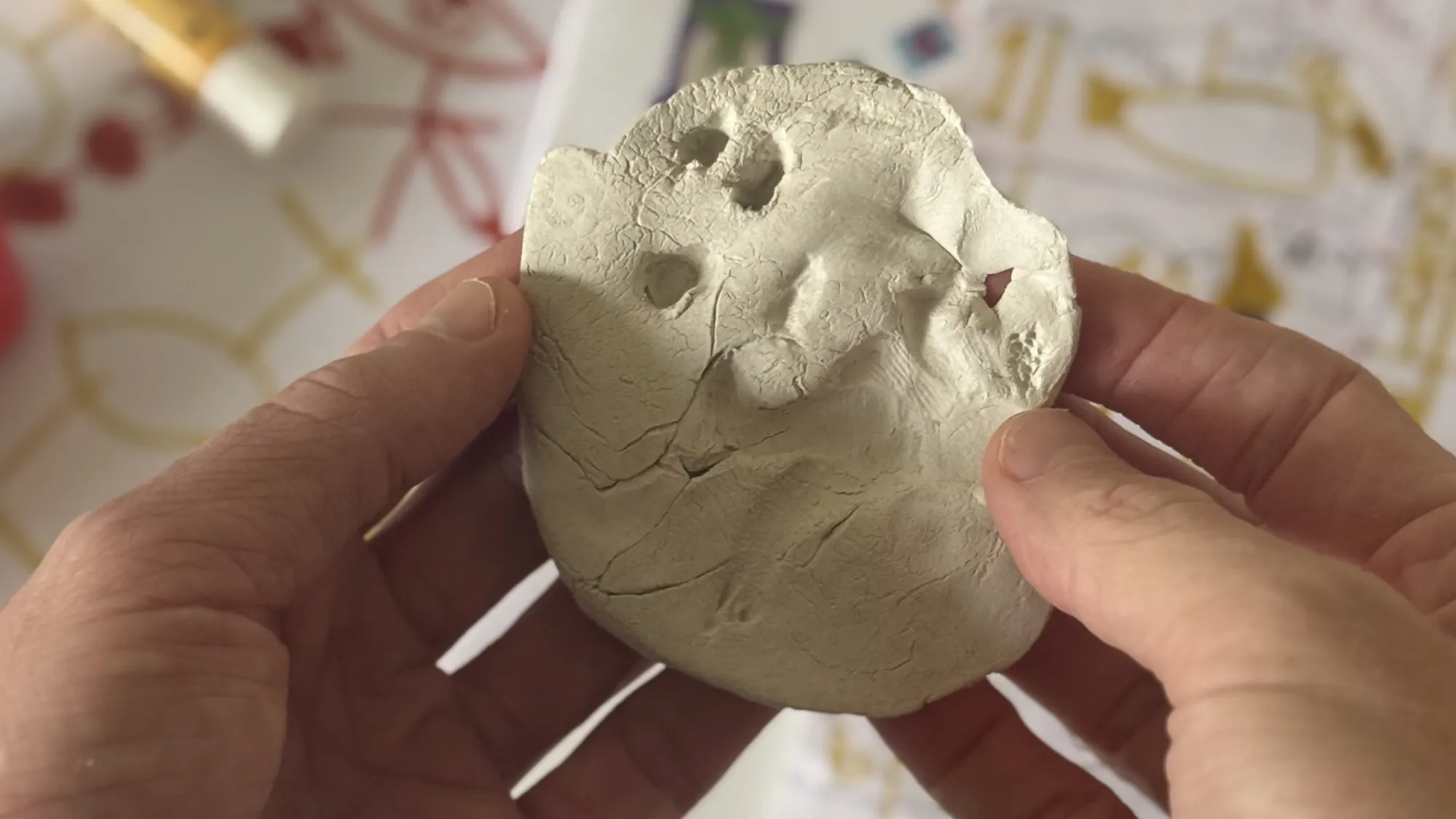
My son carried it the whole way home from kindy, in both hands, very carefully.
It was the last day of dinosaur week. The thing in his hands was a disc of white modelling clay, about the size of his palm, pressed with bumps and hollows. On the walk, he explained, very seriously, that a dinosaur had died a long, long, long time ago, and pieces of it had got caught in this fossil.
It went on the dresser in his room, among a growing heap of other collections and creations.
Drawings are easy by comparison. They fit in a folder. They stack. They can go flat in a box under the bed for twenty years and come out looking much the same.
A clay fossil doesn’t stack. Neither does a LEGO spaceship, a cardboard rocket held together with half a roll of tape, or a papier-mâché bowl that was never quite dry in the middle.
The best way to keep your kids’ 3D creations is to keep a small number of originals somewhere safe, capture the rest in 3D while they’re still whole, and write down the story behind each one while your child still remembers it. That way the thing itself and the reason it mattered don’t have to live in the same fragile object.
Why are 3D creations harder to keep than drawings?
Mostly, because of what they’re made of and how much room they take.
- They take up space. A year of drawings fits in a folder. A year of clay, cardboard and egg-carton caterpillars can fill a shelf.
- They don’t last. Air-dry clay cracks. Play-dough crumbles. Cardboard sags. Glitter goes everywhere, eventually including the vacuum cleaner.
- Some of them are meant to change. A LEGO build is usually taken apart the week after it’s finished, because the bricks are needed for the next one.
- They get dusty in the open and forgotten in a box. Shelves collect dust. Boxes collect more boxes.
None of that means they matter less. If anything, the 3D things are often the ones children remember making: the afternoon it took, the bit that kept falling off, the name they gave it.
Which of your kids’ 3D creations should you keep?
You don’t need to keep all of them. Most families can’t, and that’s fine. Three questions help:
Would you be glad to find it in ten years?
Not "is it good". Glad. The lopsided pot, the dinosaur with three legs, the robot with a bottle-cap face. If picturing it in a box in ten years makes you smile, it’s a keeper.
Does it have a story attached?
Some pieces come with an explanation that is far better than the object. "It’s a house for the cat next door." "That’s you, and that’s the car, and that’s the rain." When there’s a story, keep the story, even if you don’t keep the thing.
Will it survive?
Be honest about the materials. A fired clay piece will last for decades. A play-dough snail will not last the month. The fragile ones are the best candidates for saving in 3D first and letting go of later.
A gentle rule of thumb: keep one or two originals a term, and save the rest in another way.
Is a photo enough for a clay model or LEGO build?
A photo is a good start. It’s quick, and it’s far better than nothing.
But a photo of a 3D thing only shows one side. It misses the back, where the thumbprints are. It misses how deep the fingers pressed, the cracks, the wobbly base, the way the LEGO spaceship has a secret room underneath that you only see if you pick it up.
A 3D capture keeps the whole object: every side, turnable with a finger, at the size it really was. For something that was made to be held, that’s much closer to the real thing.
If you’re photographing instead, take a few shots from different sides (front, back, top, and one close-up of the detail your child is proudest of) rather than one straight-on picture.
How do you capture a kids’ clay model or LEGO creation in 3D?
Keepsake can save a 3D creation on an iPhone with a LiDAR scanner (iPhone 12 Pro and later Pro and Pro Max models). It takes a few minutes:
- Choose a 3D object as the type of keepsake.
- Set the object on a flat, plain surface, somewhere you can walk all the way around it. A table in the middle of the room works better than a bench against a wall.
- Use soft, even light. Bright window light on a cloudy day is ideal. Avoid harsh direct sun and strong shadows.
- Fit the box snugly around the object when the app asks, then walk slowly all the way around it, keeping it in view.
- Go around again, once from lower down and once from above, when the app prompts you. More angles means a better model.
- Save it, and add the story. Who made it, how old they were, what it is (according to them), and anything they said about it.
The 3D model is built on your phone, and your keepsakes live in your own iCloud, not on a public platform.
A few honest limits: very shiny, see-through or very dark objects can be hard to capture, and tiny, spindly things (a pipe-cleaner spider, say) may not come out as well as something chunky. If a scan doesn’t work, a few photos from different sides and a good story are still worth saving.
Once it’s saved, you can turn the model with your finger whenever you like. With Keepsake Premium, you can also view it in AR, back on the dresser, at its real size.
How do you store the original 3D creations you keep?
For the handful of originals that stay:
- Display a few, rotate them. A single shelf or a shallow shadow box for the current favourites. When something new comes in, something older can move to the box.
- Box the rest with a bit of care. A sturdy box, tissue paper or a tea towel around anything fragile, heaviest things at the bottom.
- Label the underside. A small sticker with the name of the piece (their name for it, not yours), the age, and the month. It takes ten seconds and saves a lot of guessing later.
- Keep them out of the sun and the damp. Sunlight fades paint and paper; a damp garage softens cardboard and cracks clay.
- For LEGO, save the build, not the bricks. Capture the finished model in 3D (or photograph it from every side) before it’s taken apart. The bricks will become something else, and that’s what they’re for.
What about the ones you let go?
Letting something go is easier when you know you haven’t lost it.
If your child is old enough, involve them. Ask which ones they’d like to keep "for real" and which ones can be kept in the phone. Children are often more relaxed about this than adults, especially when they get to watch their creation turn around on the screen.
Save it first, add the story, and then let the cardboard rocket go to the recycling bin without it feeling like a loss. The rocket did its job. The afternoon spent building it is the part worth keeping.
The one on the dresser
The fossil is still on the dresser. The clay is drying out now, and the cracks are getting deeper, so it looks more like a real fossil every month.
He’d tell you that’s exactly how fossils are supposed to look.
But the part that matters most isn’t the clay. It’s the careful walk home, and the dinosaur that got caught in it a long, long, long time ago.